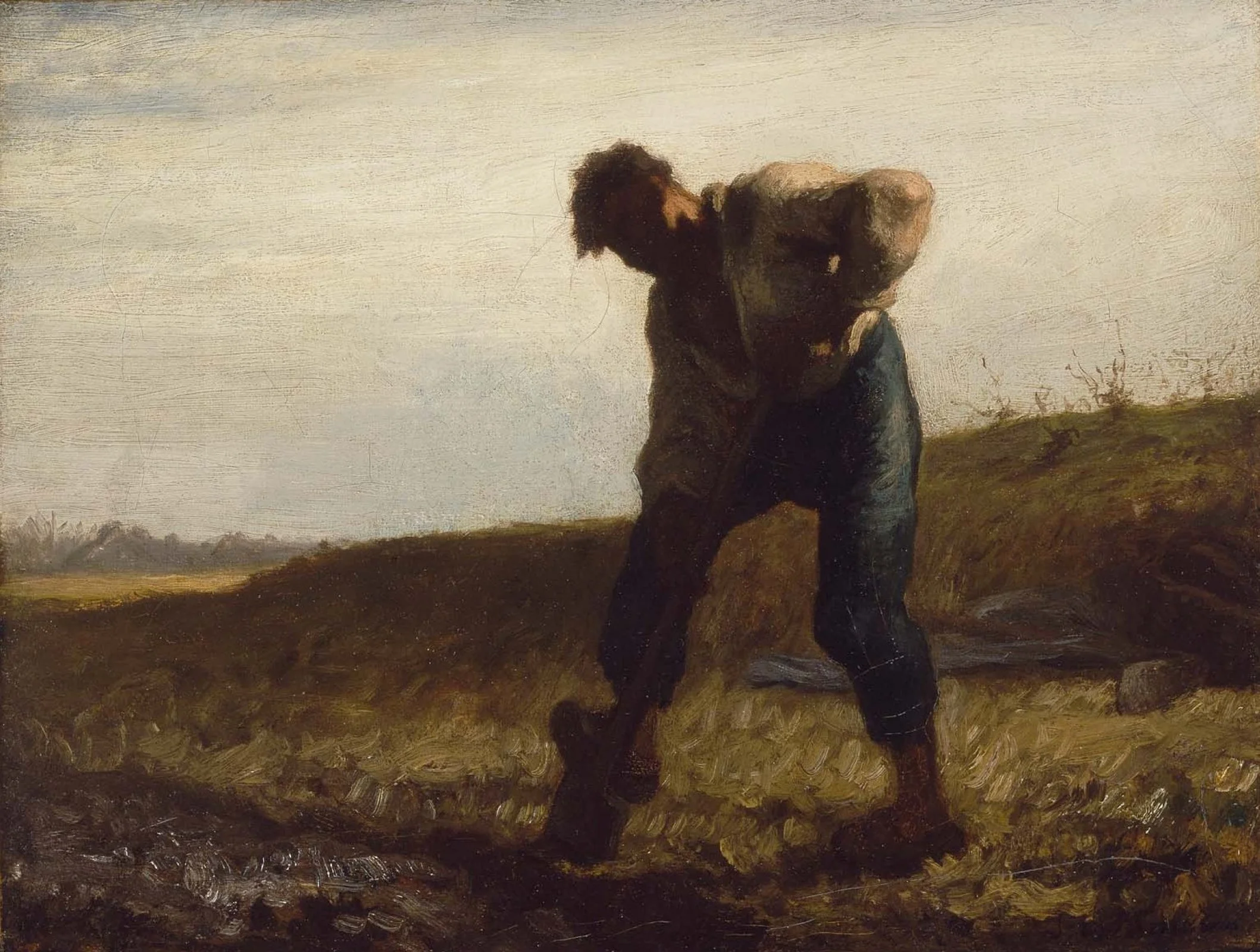
Between my finger and my thumb
The squat pen rests; snug as a gun.
Under my window, a clean rasping sound
When the spade sinks into gravelly ground:
My father, digging. I look down
Till his straining rump among the flowerbeds
Bends low, comes up twenty years away
Stooping in rhythm through potato drills
Where he was digging.
The coarse boot nestled on the lug, the shaft
Against the inside knee was levered firmly.
He rooted out tall tops, buried the bright edge deep
To scatter new potatoes that we picked,
Loving their cool hardness in our hands.
By God, the old man could handle a spade.
Just like his old man.
My grandfather cut more turf in a day
Than any other man on Toner’s bog.
Once I carried him milk in a bottle
Corked sloppily with paper. He straightened up
To drink it, then fell to right away
Nicking and slicing neatly, heaving sods
Over his shoulder, going down and down
For the good turf. Digging.
The cold smell of potato mould, the squelch and slap
Of soggy peat, the curt cuts of an edge
Through living roots awaken in my head.
But I’ve no spade to follow men like them.
Between my finger and my thumb
The squat pen rests.
I’ll dig with it.
Paraphrase
A short pen rests between my fingers, as tightly as a gun.
I hear a rasping sound outside, right under my window. My father is digging with a spade into gravelly ground. I look down outside until I see his backside as he kneels amongst the flowers in the garden. I recall twenty years ago when he would stoop like that while digging in a steady rhythm between rows of potatoes he was growing.
He would place his boot on the shovel with the shaft placed firmly against his knee. He would harvest the potatoes, bury the bright tip of the shovel in the ground, and then re-plant the seed potatoes we’d helped him pick. I remember that we loved the way they felt cold and hard in our hands.
I was so impressed by how well my father could handle a spade, just like his own father.
My grandfather could beat anyone else when it came to cutting turf [peat]. I remember carrying bottled milk to him that I had sloppily corked with some crumbled paper. He stood up straight to drink it and then went straight back to work. He cut neatly and heaved dirt over his shoulder, going down far into the earth for the good peat. He dug.
I remember the smell of cold potato mould, the sound of soggy peat squelching, the sight of the neat cuts through roots. The memories awaken in my imagination. But, I do not have a shovel to follow in their footsteps.
I have a pen wedged tightly between my fingers. I will dig with that.
Thoughts
Digging a hole is dignified work.
Never have “cold potato mould” and “the squelch and slap of soggy peat” been more romantic. It’s enough to make me want to get out into the mud and dirt with my kids right now.
In Heaney’s "Digging,” the speaker honors the past while departing from it. The speaker has no spade with which to follow his father and grandfather. He uses his pen to find connection to their dignity. He’ll dig with it.
George Eliot would have loved “Digging.” Its theme pairs with that of her greatest work, Middlemarch. The theme is encapsulated in the final line of the novel:
"…For the growing good of the world is partly dependent on unhistoric acts; and that things are not so ill with you and me as they might have been, is half owing to the number who lived faithfully a hidden life, and rest in unvisited tombs."
The speaker’s digging forefathers are exactly those unhistoric lives, and so are most of us. Indeed, most of us stand beside mastery with our sloppy corks, trying our best.
I often think of how I might someday make a difference in education, or show the world how to teach literature to children. And I would genuinely like to do those things. But sometimes those ambitions get in the way of appreciating the simple, honest work I get to do every day. Teaching a good lesson or having a deep discussion with a student about poetry does make a difference. It may be less noticeable on a grand scale, but it is just as good. This poem, with all its squelching peat and mouldy smell, is a touching reminder of the value to be found in honest work. That very work can populate a childhood with beautiful memories of dignity and fun. It can even be a steppingstone to future generations.
I may not make a sweeping change in literature education anytime soon. But I have my classroom.
I’ll dig with it.