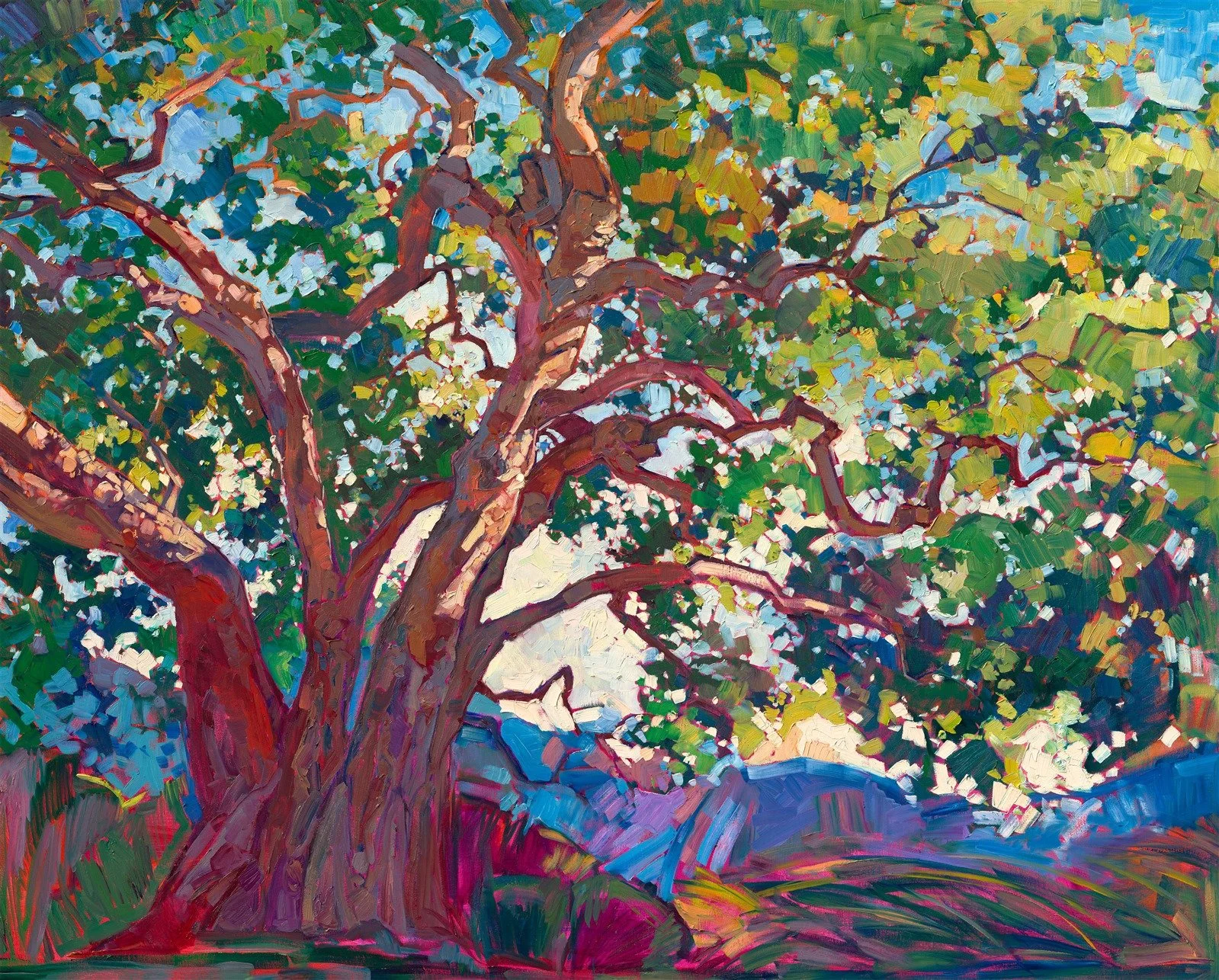
“House Oak” by Erin Hanson
Live thy Life,
Young and old,
Like yon oak,
Bright in spring,
Living gold;
Summer-rich
Then; and then
Autumn-changed
Soberer-hued
Gold again.
All his leaves
Fall'n at length,
Look, he stands,
Trunk and bough
Naked strength.
Paraphrase
Live your life, when you’re young and when you’re old, like the oak tree that is bright in the springtime, like living gold. Be covered in rich color in the summer, and then in autumn, change to the more serious shades of gold. When all the leaves have fallen, look at the oak that still stands— naked, but still the picture of strength.
Thoughts
To live “like yon oak” is to become proud of who you are without your leaves—to cultivate a soul worth showing off in all its naked strength.
In “The Oak,” Tennyson describes a strong oak tree that changes colors with the seasons. The tree is compared with our lives as we grow older. As the tree moves from spring to summer to fall to winter, its colors change until it has no leaves left, but still stands strong without its colorful garments. But what does it mean for us to live our lives like the oak?
In the spring, our youth, when we are brightly colored in living gold, we are guileless like Pollyanna. Our youthful colors are our energetic enthusiasms, without hesitation or nervousness. Like that sweet child, we play the Glad Game without the hesitation that many of us develop later on.
In summer, as we grow more mature, the colors become more rich. This is when our behaviors might begin to lack exuberant energy, but gain in their purpose. In Anne of Green Gables, when Anne Shirley, a wildly imaginative and effervescent child, grows into a calm, self-possessed young woman, she never loses her romantic imagination. She does not become dull as she grows, but rather more rich and multi-faceted.
In autumn, as the colors deepen and turn even more gold, this is when our experiences truly convert into maturity. We may have wrinkles in our autumn, but they have been won through the lessons of our lives. In Les Miserables, Jean Valjean reaches his autumn when he settles down with Cosette after having escaped prison for the second time. He knows what is most important to him, and he acts to protect it by living a calm, hidden life.
And finally, in the winter of old age, we will certainly be changed in appearance, but if we have lived well, we maintain all of our dignity and strength. I love Tennyson’s words about this strength—”Trunk and bough Naked strength.” Nakedness is vulnerable, and yet, as Yeats claims in “A Coat,” “there is more enterprise in walking naked.” In our winter, we have reached our final form.
Our changing leaves are the adornments we wear as we age, but the trunk within is made of what the seasons have built. May our lives be such that, when the leaves fall off, we are proud of our nakedness.