I began the year with a desk full of poetry, and I ended it with a desk full of poetry.
On the first day of literature class, poetry is an exciting preview of what is to come. On the last day, it is a perfect bow to tie on the experiences we have shared. I hope this bow signifies to my students the gift of beautiful stories that I have tried to present them with this year… No pun intended. Embedded in each poem is a hope I have for them as they go into the summer, and into a new year of school.
3rd Grade: “Sympathy” by Emily Brontë
While reading The Miraculous Journey of Edward Tulane at the end of this year, my students and I talked a lot about what the words “hope” and “despair” mean. As Edward passes through the lives of broken people, he learns to love them as they share their love with him. The brokenness of his loved ones prepare him to learn what it truly means to love someone.
But, between each new encounter, Edward falls into despair over his latest loss. Although he has always loved the stars, even their beauty fails to comfort him in these moments. I think that much of what is expressed in Edward Tulane is also expressed in Emily Brontë’s poem, “Sympathy.” I also thought it was a perfect ending to 3rd grade literature—a particularly beautiful collection of titles which share a common theme of developing resilient hope. So, this is what I chose to end 3rd grade literature with this year:
There should be no despair for you
While nightly stars are burning;
While evening pours its silent dew,
And sunshine gilds the morning.
There should be no despair—though tears
May flow down like a river:
Are not the best beloved of years
Around your heart forever?
They weep, you weep, it must be so;
Winds sigh as you are sighing,
And winter sheds its grief in snow
Where Autumn’s leaves are lying:
Yet, these revive, and from their fate
Your fate cannot be parted:
Then, journey on, if not elate,
Still, never broken-hearted.
I hope the spirit of this poem lives around their hearts forever.
4th Grade: “To a Lady Seen from the Train” by Frances Darwin Cornford
I love Just David by Eleanor H. Porter, and my class even performed a scene from it for our end of year recital. It is about a little boy who is sheltered by his father from everything in the world, excepting only the things that are “the good and the beautiful.” When David must travel away from his peaceful, beautiful home on a mountain, he comes upon people like you and me. The people are shocked to find a boy who does not understand the concept of death, and David is equally shocked to find people who are not stunned into awed silence by the beauty of every sunset. This poem is David all over:
O why do you walk through the fields in gloves,
Missing so much and so much?
O fat white woman whom nobody loves,
Why do you walk through the fields in gloves,
When the grass is soft as the breast of doves
And shivering sweet to the touch?
O why do you walk through the fields in gloves,
Missing so much and so much?
With this poem, I hope my students remember to remove their own gloves next time they walk through a metaphorical field of tall grass.
5th Grade: “The Human Seasons” by John Keats
We finished reading The Secret Garden two days before the end of the school year. The seasons play a part in the development of the story, and we talked a lot about how the coming spring mirrors the healing of two of the principal characters. Naturally, I had to share “The Human Seasons” with them.
Four Seasons fill the measure of the year;
There are four seasons in the mind of man:
He has his lusty Spring, when fancy clear
Takes in all beauty with an easy span:
He has his Summer, when luxuriously
Spring's honied cud of youthful thought he loves
To ruminate, and by such dreaming high
Is nearest unto heaven: quiet coves
His soul has in its Autumn, when his wings
He furleth close; contented so to look
On mists in idleness—to let fair things
Pass by unheeded as a threshold brook.
He has his Winter too of pale misfeature,
Or else he would forego his mortal nature.
I hope my students will all enjoy luxurious summer, chewing the honied cud of all the stories we have enjoyed this year. May those stories enrich all the seasons of their lives.
6th Grade: “If—” by Rudyard Kipling
My final class with the 6th graders was a little difficult for me because, next year, I will no longer be their literature teacher. I have taught this class since they were in second grade, and I feel very attached to the students. Although I will still teach a poetry class to them once per week for the next two years, it’s not quite the same as seeing them every day the way I do now. Rather than tying a bow on the year, this lesson felt like tying the bow on five years. I could think of no better way to do that than by sharing “If—” by Rudyard Kipling.
We slowly went through the poem to make sure we understood the words. What started to happen after a couple of lines surprised me, but maybe it shouldn’t have. We would paraphrase a line, and then a student would pipe in with a connection to a book we had read together over the past five years.
Me, reading: ”If you can meet with Triumph and Disaster
And treat those two imposters just the same—”
Student: “—Like Edward Tulane!” [The Miraculous Journey of Edward Tulane, 3rd grade]
Me, reading: “Or being hated, don’t give way to hating—”
Student: “—Like Sara Crewe!” [A Little Princess, 4th grade]
And so on.
With “If—,” my hope was perfectly captured by a student during discussion that day. She said, “I think this poem is a perfect way to capture what is important about literature. When we read great literature, we understand more about what it is to be human.” May “If—,” along with everything else we have enjoyed together, serve to show these amazing people the wonders of being human.
I love teaching literature, and one of my dearest hopes for myself is that I can imbue my students with a love of great stories and poems.
And now, to summer. My hope for all of you is that you will enjoy it!
If you can keep your head when all about you
Are losing theirs and blaming it on you,
If you can trust yourself when all men doubt you,
But make allowance for their doubting too;
If you can wait and not be tired by waiting,
Or being lied about, don’t deal in lies,
Or being hated, don’t give way to hating,
And yet don’t look too good, nor talk too wise:
If you can dream—and not make dreams your master;
If you can think—and not make thoughts your aim;
If you can meet with Triumph and Disaster
And treat those two impostors just the same;
If you can bear to hear the truth you’ve spoken
Twisted by knaves to make a trap for fools,
Or watch the things you gave your life to, broken,
And stoop and build ’em up with worn-out tools:
If you can make one heap of all your winnings
And risk it on one turn of pitch-and-toss,
And lose, and start again at your beginnings
And never breathe a word about your loss;
If you can force your heart and nerve and sinew
To serve your turn long after they are gone,
And so hold on when there is nothing in you
Except the Will which says to them: ‘Hold on!’
If you can talk with crowds and keep your virtue,
Or walk with Kings—nor lose the common touch,
If neither foes nor loving friends can hurt you,
If all men count with you, but none too much;
If you can fill the unforgiving minute
With sixty seconds’ worth of distance run,
Yours is the Earth and everything that’s in it,
And—which is more—you’ll be a Man, my son!
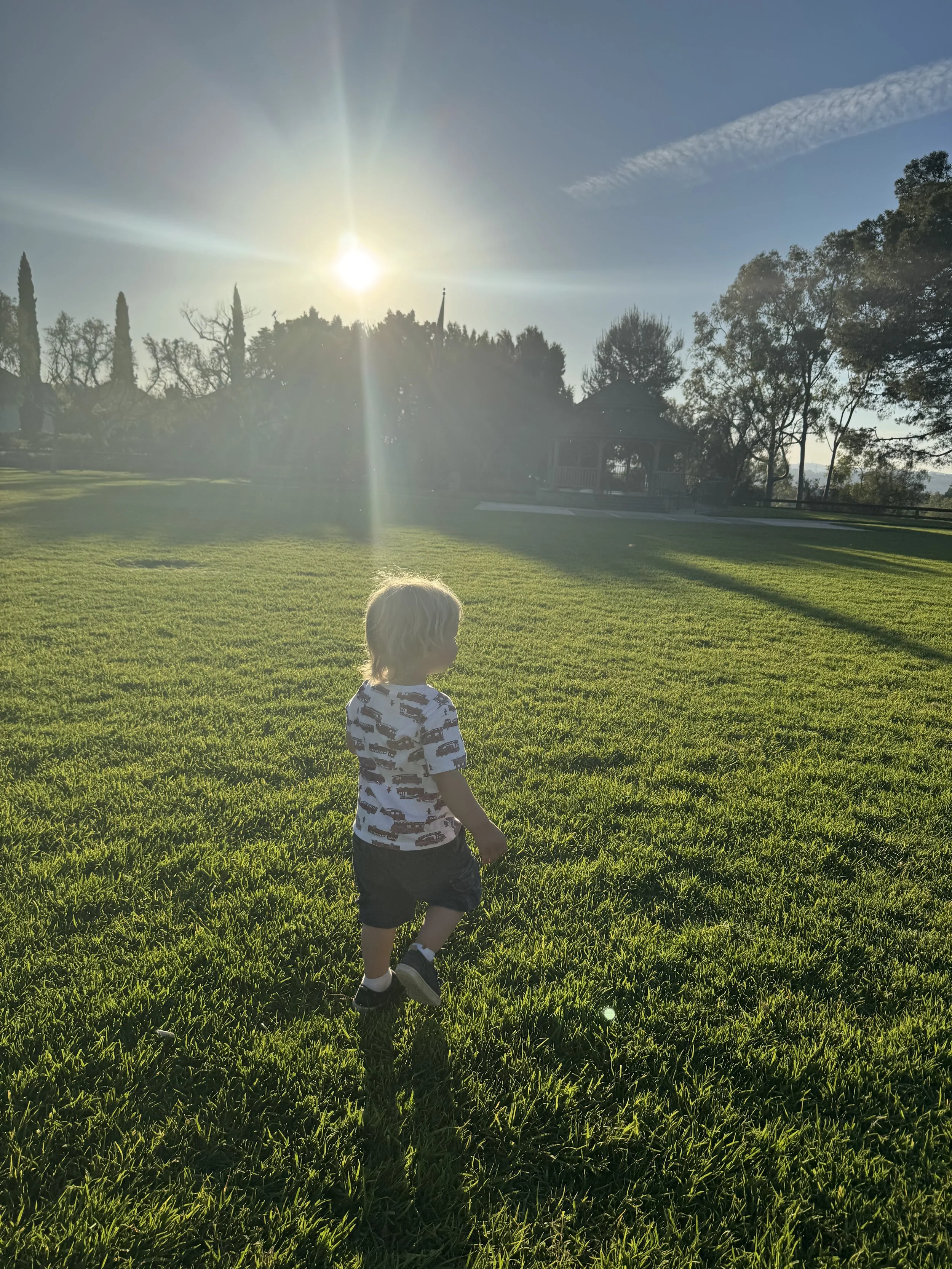
This is my son, running into summer. Let’s chase that sunshine, little boy!