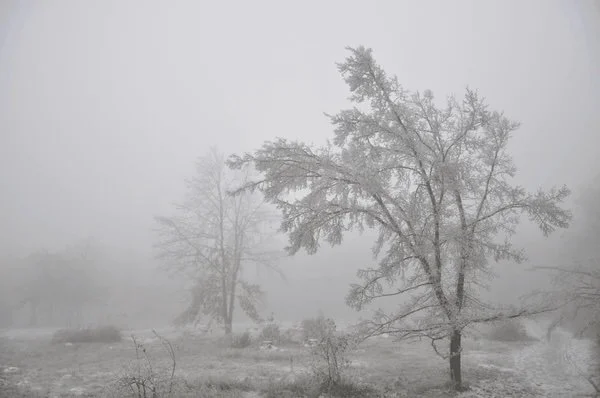
The night is darkening round me
The wild winds coldly blow;
But a tyrant spell has bound me,
And I cannot, cannot go.
The giant trees are bending
Their bare boughs weighed with snow;
The storm is fast descending,
And yet I cannot go.
Clouds beyond clouds above me,
Wastes beyond wastes below;
But nothing drear can move me;
I will not, cannot go.
In My Own Words
It is getting dark around me, and the cold wind is blowing hard. But something powerful and cruel is keeping me right here. I can’t leave.
The trees are bending under the force of the wind and their limbs are weighed down with cold snow. The storm is getting stronger very quickly, but I cannot leave.
There are countless clouds above me, and nothing but wasteland under my feet. But nothing gloomy can make me move. I will not leave. I cannot leave.
Reflection
Emily Brontë has a special place in my heart. Of the three Brontë sisters, her poetry is my favorite. (Although I will take Charlotte’s Jane Eyre over Emily’s Wuthering Heights any day!)
This poem is a bit vexing. The first two stanzas of the poem are aligned in their helpless tone, but then there is a huge shift with the last line: “I will not, cannot go.” While “cannot” implies that something is forcing the speaker to remain, “will not” implies agency and even stubbornness. To add further complication, we can look at the title: “Spellbound.” This word has a strongly positive connotation, and refers to being captivated or full of wonder. These two complications seem small, but their implications have the potential to shift the meaning of the poem.
When I have taught this poem in the past, students have suggested that the speaker might remain in the cold, windy landscape because, even though most people find it intolerable, she loves it. I actually really enjoy this interpretation, despite the fact that anywhere else you look online, it will say something else. This interpretation does fit with the connotations of “will not, cannot” and “Spellbound.” And, more than that, this interpretation fits with my own understanding of Emily Brontë.
Emily Brontë had an interesting sense for aesthetics. She loved writing about darkness and intensity. Wuthering Heights offers plenty of evidence for that. I also love her poem “Stars,” which is about wanting to be nocturnal so the “hostile light” of the sun need never touch her. She goes on to acknowledge that although the “soul of nature sprang elate” at the dawning of the sun, her speaker’s soul “sank sad and low.” She ends by saying to the stars, “Let me sleep through his blinding reign, And only wake with you.” Emily had a unique taste for what was beautiful, and often saw it in places that others did not.
Might Emily be like Robert Frost, and enjoy watching “the woods fill up with snow?”
Most people suggest that this poem is what it looks like—a description of being hopelessly held in place to confront a disastrous storm. Many posit that the external storm mirrors internal grief that the speaker stubbornly confronts, despite the pain of it. People smarter than I have read this poem, and they are probably right. But, I will always keep a little wonder tucked away about this poem. Might it actually be about the love Emily harbored for the beauty she saw in dark places?
I love Emily Brontë’s gothic sensibilities.