One wading a Fall meadow finds on all sides
The Queen Anne’s Lace lying like lilies
On water; it glides
So from the walker, it turns
Dry grass to a lake, as the slightest shade of you
Valleys my mind in fabulous blue Lucernes.
The beautiful changes as a forest is changed
By a chameleon’s tuning his skin to it;
As a mantis, arranged
On a green leaf, grows
Into it, makes the leaf leafier, and proves
Any greenness is deeper than anyone knows.
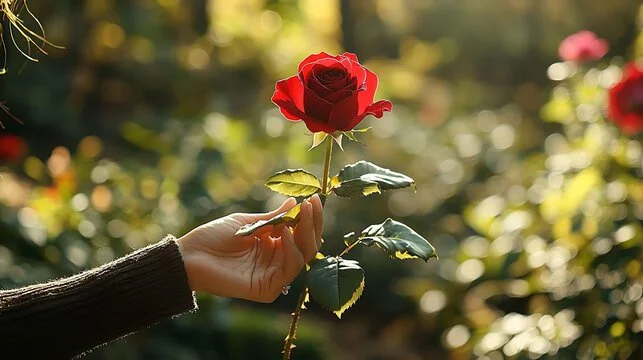
Your hands hold roses always in a way that says
They are not only yours; the beautiful changes
In such kind ways,
Wishing ever to sunder
Things and things’ selves for a second finding, to lose
For a moment all that it touches back to wonder.
In My Own Words
Someone walking through a meadow of tall grass can see the flowers at the tips, looking like lilies on the surface of water. As the wind blows, they appear to glide across the surface. From the walker’s perspective, this changes the meadow of dry grass into a flowing body of water, just as the smallest reminder of you turns my mind into a valley of blue flowers.
Beauty changes, just like the forest changes as a result of a chameleon matching itself to it. Or, like a praying mantis makes a leaf even more like a leaf just by perching on it, proving that the greenness of nature is more complex than anybody can fathom.
When you hold roses, you do so in such a way that makes it look as though the flowers belong to more than just you. The beautiful changes in flattering ways, always trying to separate things from themselves, so they might find each other again. Losing itself for a while makes the reuniting moment even more wonderful, increasing its beauty.
In “The Beautiful Changes,” Richard Wilbur shows us that beauty, by its very nature, is increased and even defined by change. The field in the first stanza is beautiful because, through it, the walker is also walking in a pond, in a different field of blue flowers, and is reminded of his lover. The forest is made beautiful by the chameleon matching a shade of it, and the leaf is made more alive and more itself by the praying mantis that perches on it. A rose, when held by a loved one, becomes more than just a rose.
Many a time and oft have I longed for the preservation of a perfect moment. An hour after my daughter was born, she fell asleep for her first Earthside nap just as the sun was rising. She lay in the hospital bassinet, between my bed and the large window, just as the sun was rising. It crested the horizon and framed her little body perfectly. I cherish that memory, along with many others. It does not fade with time.
Rather, that moment grows richer every day as I experience more and more life with my daughter. Now she is four, and as I remember her first sunrise, I am filled with awe at all of the things about her I didn’t know yet. I am floored by the beauty and connection of that moment, which happened long before I understood how naturally caring she is with younger children, how generous she is with her belongings and treats, how she helps anybody who is crying, and how she makes me laugh with her stubbornness and humor. That baby in my memory is enriched every day by the child she has become, and the remembered infant will continue to grow in sweetness as the child becomes an adult.
The things we see, the moments we remember, they are all beautiful on their own. But, Wilbur is right—they change. They get better. A flower is so much more than a flower when it is held by someone precious to us. A lost belonging is more cherished than ever once it is found.
Somehow, in “The Beautiful Changes,” Wilbur takes us from a field to a forest, then to a garden, and finally into our own sense of perception. We see that, like the world surrounding us, we change too.
This poem is alive. It changes as it teaches us how the beautiful changes.