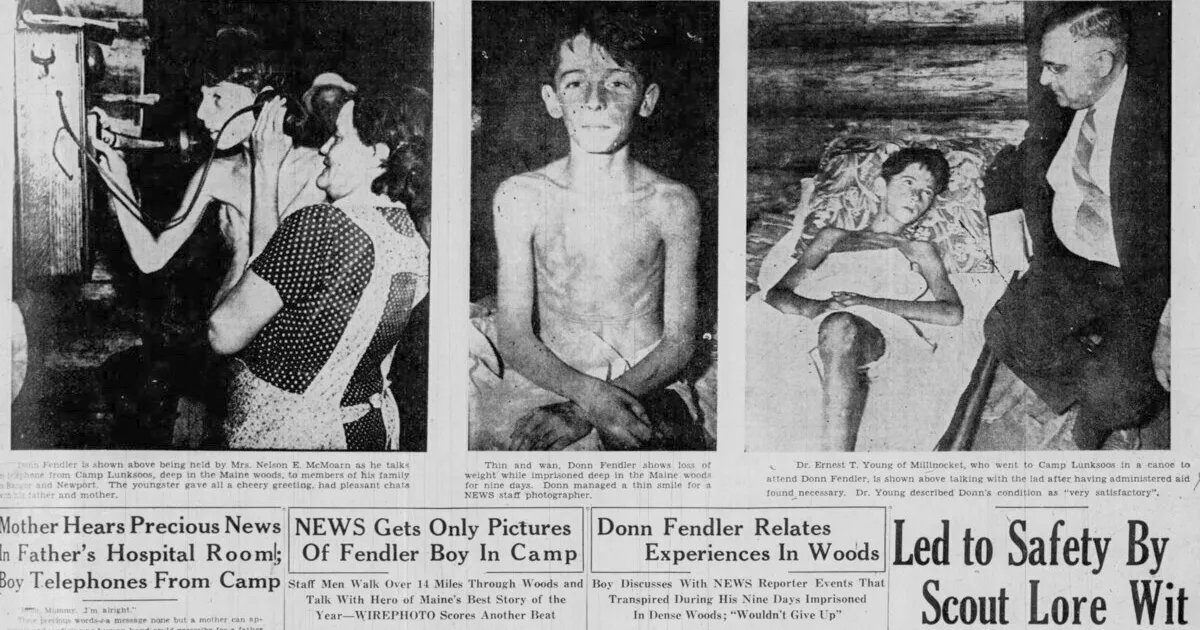
The tiniest book I teach is Donn Fendler’s Lost on a Mountain in Maine. I’ve taught it for three years now, and despite its small size, it is quite memorable.
The book is the narrator’s true account of when he was lost on Mt. Katahdin in Maine for nine days. And, more than any of the episodes he recounts, the thing everyone remembers most is Donn’s character. In fact, I was holding the book when I walked into a classroom full of kids who had read it with me the previous year, and immediately four of them cried out something like, “I love that boy so much.”
When Donn is starving and lost on an unforgiving mountain for days, he wakes up each morning and says his prayers. First, he prays for his “Mommy and Dad,” and that they won’t worry. Then he prays for all the other children in the world. Then he prays for something to eat. After his prayers, he gets up and starts walking. The boy never stops walking. This is actually part of the reason it was so difficult to find him—nobody expected him to cover so much ground. Donn loses his pants and his shoes. He loses part of his toe, for crying out loud. But each time he loses something, he literally shrugs his shoulders and keeps walking. His perseverance is incredible.
Through it all, Donn keeps thinking about his dad and his brothers, hoping that his own disappearance won’t take too much time out of the next leg of their family trip. He laughs when he makes silly mistakes. He talks to a chipmunk and rejoices in its company.
The book ends with an epilogue detailing everything that went into trying to find Donn while he was missing. That is a remarkable tale on its own. Over nine days, and even after the searchers were sure they were only looking for a body, park rangers tirelessly trekked the mountain while local factories halted production in order to donate their trucks to the search effort. Even after the factories started up business again, the men who worked there willingly took hits to their paychecks so they could go search for this boy, if only to restore his remains to his parents. Human dignity is at its best in this epilogue.
Here are some of the insights my students shared during discussion:
Donn’s prayers help him so much. If he had just been thinking about how miserable he was, he never would have gotten out.
I admire how calm he is. He gets scared and cries, of course, but he recovers. If that were me, I would run around screaming until I died or something.
I love that he calls his mom “Mommy.” I love that he just keeps walking. He is so innocent, and he never loses hope that he is going to be okay.
When I read this book, and really all of the books from literature class, they make me see things like I’m another person. I’ve never been lost on a mountain. I never will be. But I feel like I kind of know what that is like … a little bit.
This small, unassuming book is a lot like the hero it describes. Both are so simple and so small. But, both the book and the hero are powerful in their pure honesty, and in their underlying belief that things will turn out okay.